
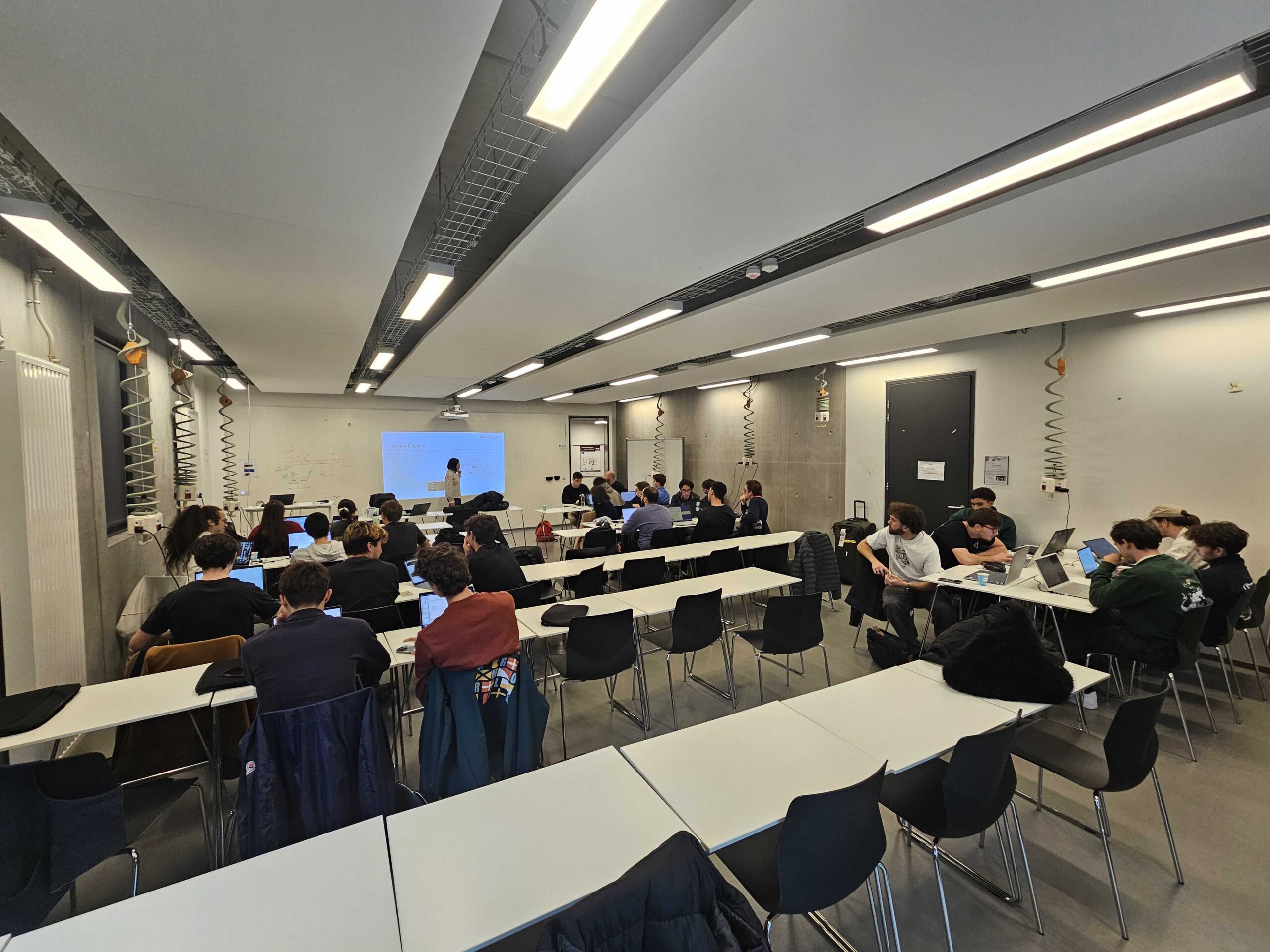
Another year working with the talented students of CentraleSupélec in Paris during an intensive week of railway system engineering using the latest Prover tools.
Exploring the interlocking’s full lifecycle
Our goal was to help them explore the entire lifecycle of a railway interlocking system, from layout design and safety requirements to formal verification and testing, all supported by Prover Studio and Prover iLock. The challenge was to build a complete railway line with 7 interlockings, prove the safety of the line, and simulate the behaviour of the whole system.
We began by introducing the fundamentals of railway signalling and explaining what an interlocking is. Equipped with this knowledge, the students first debugged an existing interlocking system following fundamental signalling principles by using formal verification.
Once confident, they defined and verified new safety requirements, created test cases, and implemented a manual release feature, addressing design, safety, and testing aspects within a single, integrated workflow.
Impressive Progress and Collaboration
We extend our warmest thanks to the CentraleSupélec students for their commitment and enthusiasm throughout the week. They impressed us with how quickly they are handling our tools, modelling language, and dealing with the complexities of the railway domain. Special thanks also go to Idir Ait Sadoune and the teaching team for renewing their trust in us again this year.
At Prover, we firmly believe that introducing formal methods and signalling engineering to the next generation of engineers is essential for building safer and more reliable railway systems. We look forward to seeing these talented students again, in the railway industry or the field of formal verification, as they help engineer a safer world.
Share this article

Learn to build a solid safety case for rail control systems using formal verification
Fill out your information here.
More News & Articles
Prover, RATP and Systerel publish the unified HLL 4.0 specification, keeping the rail industry's formal verification language open and free of dialects.

Generative AI has entered railway software engineering ahead of the standards governing it. A new CENELEC draft amendment to EN 50716 doesn't add requirements. It clarifies which existing rules apply when AI drafts specs, writes code, or generates test cases, and why those rules are harder to satisfy with generative models than teams might assume.

Prover, together with NEAT, Schneider Electric, and Pilz will demo real railway interoperability at InnoTrans: three vendor platforms, one interlocking design, live at Prover's booth.


