Strengthen signaling procurement with
model-based requirements
Strengthen signaling procurement with model-based requirements
Railway signaling tenders are often built on complex requirements that are difficult to interpret, compare, and verify.
Prover helps railway teams turn signaling requirements into structured, model-based tender foundations that make supplier solutions easier to compare, assumptions easier to validate, and procurement decisions easier to justify.
From tender ambiguity to comparable proposals
When requirements are hard to compare, procurement risk moves downstream
Railway signaling procurement is complex. Infrastructure managers need to specify what the system must achieve, suppliers need to interpret and respond to those requirements, and evaluators need to compare proposals that may use different architectures, tools, assumptions, terminology, and delivery models.
Different interpretations
Requirements are interpreted differently by different suppliers.
Difficult comparison
Tenders are difficult to compare objectively across proposals and assumptions.
Implicit assumptions
Important assumptions remain implicit until late in the project.
Clarification loops
Ambiguities create supplier clarification loops and contract risk.
Weak validation
Infrastructure managers struggle to validate whether proposed solutions meet the real operational intent.
Downstream rework
Weak requirement baselines create change orders, rework, disputes, and delays later.
Procurement is where signaling risk should be reduced, not created
A signaling procurement process does more than select a supplier. It defines the foundation for the entire project lifecycle. When the tender foundation is structured and testable, procurement becomes a stronger control point for project quality.
Level 0 — Create the truth
Trusted procurement baseline
Structure requirements, assumptions, scenarios, interfaces, and evaluation criteria into a trusted procurement baseline.
Level 1 — Build and prove
Supplier validation
Use structured requirements and models to support supplier comparison, solution validation, verification planning, and acceptance readiness.
Level 2 — Evolve safely
Lifecycle governance
Reuse model-based requirements as a reference for upgrades, changes, re-procurement, and lifecycle governance.
What you gain from Model-based Requirements
Model-based requirements help turn procurement into a more transparent, comparable, and verification-ready decision process.
Clearer tender foundations
Create a structured requirements baseline that is easier for suppliers, evaluators, consultants, and internal teams to understand.
Better supplier comparison
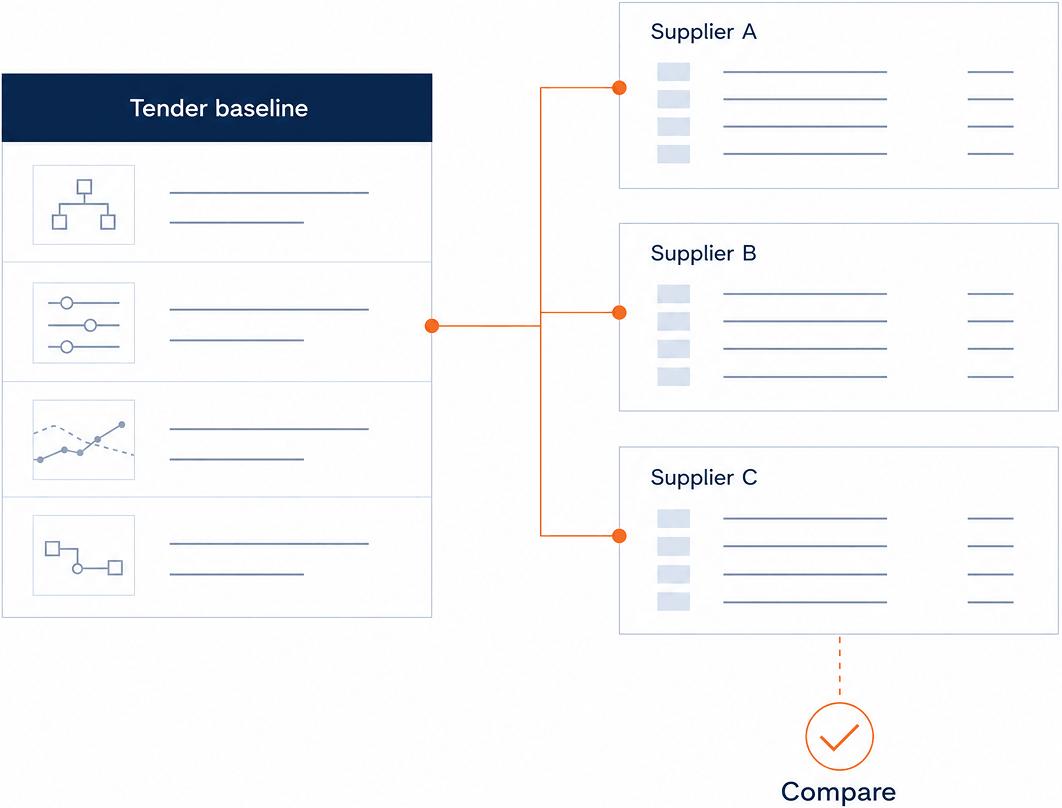
Make proposals easier to compare by aligning them against a common model, structure, terminology, and evaluation logic.
Reduced ambiguity
Identify unclear, conflicting, incomplete, or unverifiable requirements before they create downstream cost and risk.
Earlier validation of assumptions
Use models, scenarios, or digital twins where feasible to test intended system behavior and supplier assumptions.
Stronger procurement confidence
Support more transparent and evidence-based decisions in complex signaling procurements.
Better handover to delivery
Create requirements and evaluation outputs that can be reused in design, verification, acceptance, and safety evidence activities.
For teams responsible for signaling procurement and early project confidence
Infrastructure managers
Improve tender quality, reduce interpretation risk, compare supplier proposals more consistently, and create a stronger foundation for delivery and lifecycle control.
Suppliers & integrators
Clarify customer expectations earlier, reduce ambiguity in tender responses, and create a more precise basis for design, estimation, verification, and delivery.
Consultants & engineering firms
Help infrastructure managers define requirements, prepare tender material, evaluate supplier responses, and reduce procurement-related project risk.
Start from the procurement challenge you have today
Start from the data challenge you have today
Prepare a model-based tender baseline
Structure requirements, scenarios, interfaces, and assumptions before a tender is released.
Are our requirements clear, complete, comparable, and ready for tender?
Validate existing tender requirements
Review and improve an existing requirements set before procurement or before final supplier evaluation.
Will suppliers interpret these requirements in the same way?
Support supplier proposal comparison
Use structured requirements, evaluation criteria, and models to compare supplier responses against the same baseline.
Which proposal best satisfies the intended system behavior and project constraints?
Create a digital twin for procurement evaluation
Create a model or digital twin that can be used to test assumptions, evaluate scenarios, or compare proposed solutions.
Can we validate key supplier assumptions before awarding or committing to delivery?
Build reusable requirements for future programs
Create a structured requirements foundation that can be reused across multiple lines, regions, suppliers, or future modernization programs.
Can we create a reusable model-based requirement baseline for future signaling procurements?
Applicable across signaling procurement and early project definition
Interlocking systems
Structure requirements around routes, objects, interfaces, control principles, safety rules, operational scenarios, and verification expectations.
ERTMS and ETCS programs
Create a clearer requirement and evaluation baseline across standards, national rules, supplier assumptions, and site-specific data.
CBTC and Metro systems
Make requirements for capacity, headway, degraded modes, automation levels, interfaces, and constraints more comparable and testable.
Digital twins and synthetic environments
Support procurement by validating scenarios, testing assumptions, or creating a shared behavioral reference before supplier selection.
Open signaling and COTS architectures
Define interfaces, responsibilities, constraints, and evaluation criteria to support modularity and reduce vendor lock-in.
Modernization and migration programs
Create a model-based requirement baseline before legacy behavior is migrated or re-engineered.
Learn more about model-based procurement

Learn how to turn fragmented signaling requirements, specifications, and engineering knowledge into a structured, traceable, and trusted baseline. This webinar explores how Requirement Engineering and Specification Intelligence create a stronger foundation for digitalization, verification, automation, migration, and AI-assisted engineering.

Learn how open signaling helps infrastructure managers reduce lifecycle costs, avoid vendor lock-in, and gain greater control of their signaling systems. This webinar explores how open standards, COTS-based architectures, and a competitive supplier ecosystem enable more flexible and sustainable railway signaling.

How can rail projects move beyond manual data preparation? In this webinar, we show how Signaling Design Automation and formal verification enable a more controlled, efficient, and verifiable approach to generating and validating application data.