Migrate legacy signaling systems to open, modern architectures with confidence
Migrate legacy signaling systems to open, modern architectures with confidence
Many railway networks still depend on legacy signaling and traffic management systems that are reliable but increasingly difficult to maintain, document, modify, and integrate with modern digital control environments.
Prover helps railway teams migrate from legacy systems to modern, modular, open COTS-based signaling architectures using digital twins, structured migration methods, simulation, formal verification, and staged regression testing.
Move from unknown legacy behavior to a verified, future-ready architecture
Legacy systems are reliable until they become too hard to change
Many legacy signaling systems were built to last. But the challenge is no longer only whether the legacy system works today. The challenge is whether it can continue to be maintained, modified, extended, integrated, and assured tomorrow.
Shrinking expertise
Critical knowledge is held by a shrinking number of experts.
Incomplete documentation
Documentation is incomplete, outdated, or inconsistent with the real system.
Aging components
Spare parts and legacy competencies become harder to secure.
Hidden dependencies
Migration plans carry high uncertainty and hidden dependencies.
Late discovery
Errors are discovered late during integration, testing, commissioning, or operation.
Closed architectures
Infrastructure managers remain dependent on closed architectures or aging technologies.
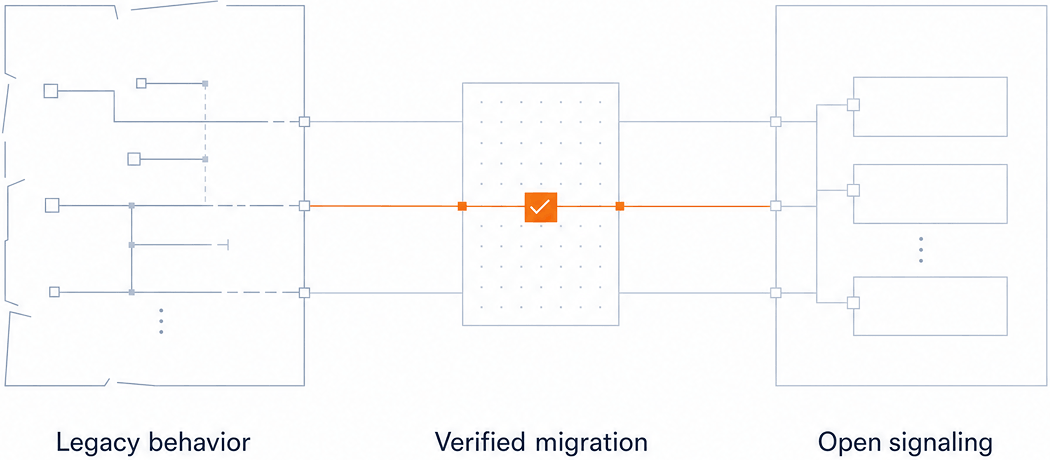
Migration is not replacement. It is a controlled transfer of behavior.
A signaling migration project is rarely a simple remove-old-system, install-new-system exercise. The key question is whether the new system preserves required behavior, improves maintainability, and avoids unacceptable risk.
Level 0 — Create the truth
Legacy behavior baseline
Capture and structure legacy system behavior, data, requirements, and assumptions.
Level 1 — Build and prove
Verified target system
Model, simulate, generate, verify, and validate the target system or migrated subsystem.
Level 2 — Evolve safely
Controlled modernization
Manage staged rollout, regression verification, lifecycle change, and long-term modernization.
What you gain from legacy migration to open signaling
Create a controlled path from aging systems to modern, modular, and future-ready signaling architectures.
Stronger legacy understanding
Create a structured and simulation-ready view of legacy behavior, logic, interfaces, assumptions, and dependencies.
Reduced equivalence risk
Verify that the new system preserves required behavior while supporting modernization.
Safer phased migration
Replace selected components step by step instead of forcing high-risk big bang migration.
Better modernization control
Move toward open, modular, and COTS-based architectures while maintaining control over critical logic.
Earlier issue detection
Find gaps, mismatches, interface issues, and behavioral differences before field deployment.
Reduced vendor lock-in
Gain more control over signaling architecture, upgrade strategy, and long-term lifecycle choices.
For teams responsible for modernization without losing operational control
Infrastructure managers
Reduce the risk of modernizing aging signaling assets, moving away from obsolete technologies, and creating more open, maintainable architectures.
Suppliers & integrators
Reduce delivery risk when replacing, interfacing with, or upgrading legacy signaling logic.
Consultants & engineering firms
Assess migration readiness, define modernization roadmaps, support technology selection, and reduce hidden legacy behavior risk.
Start from the migration challenge you have today
Start from the data challenge you have today
Relay or mechanical interlocking migration
Support migration from relay-based or mechanical interlocking environments to computer-based or COTS-based architectures.
Can we migrate existing interlocking behavior without losing safety or functionality?
Non-vital relay logic to PLC migration
Replace non-vital relay logic or route-setting logic with PLC-based software while keeping vital interlockings in place.
Can we replace selected relay logic while preserving correct interaction?
Legacy traffic management modernization
Support migration from old operator panels or legacy TMS interfaces to modern digital TMS.
Can we modernize the operational layer while keeping signaling behavior controlled?
Proprietary system to open signaling
Support a move from closed vendor-specific environments toward modular, open, and COTS-based architectures.
Can we migrate toward open architecture without increasing safety or integration risk?
Legacy signaling to ETCS migration
Support migration planning, data baselining, behavioral modeling, verification, and staged transition.
Can we control the transition to the future ETCS-based operating model?
Applicable across legacy-to-modern rail control migration
Relay-based interlockings
Capture relay behavior, create digital twins, and support controlled migration to modern platforms.
Non-vital relay logic
Replace non-vital relay logic with PLC software or another modern control layer while vital interlocking remains in place.
Traffic management system migration
Safely integrate modern TMS platforms with existing or future signaling logic.
Computer-based interlocking replacement
Upgrade, replace, or integrate proprietary computer-based interlockings with new open interfaces.
ETCS and digital signaling migration
Support modeling, data preparation, verification, and staged migration to new train control architectures.
Open signaling and COTS architectures
Support migration toward modular architectures using COTS components, open interfaces, reusable models, and structured verification.
Learn more about safe signaling migration

Learn how to turn fragmented signaling requirements, specifications, and engineering knowledge into a structured, traceable, and trusted baseline. This webinar explores how Requirement Engineering and Specification Intelligence create a stronger foundation for digitalization, verification, automation, migration, and AI-assisted engineering.
Learn how open signaling helps infrastructure managers reduce lifecycle costs, avoid vendor lock-in, and gain greater control of their signaling systems. This webinar explores how open standards, COTS-based architectures, and a competitive supplier ecosystem enable more flexible and sustainable railway signaling.

How can rail projects move beyond manual data preparation? In this webinar, we show how Signaling Design Automation and formal verification enable a more controlled, efficient, and verifiable approach to generating and validating application data.