
Create a trusted data baseline before engineering, simulation, verification or migration
Railway signaling projects depend on complete, consistent, and usable data. This focused assessment helps you evaluate, structure, and validate signaling data for a defined scope.
The goal is simple: can the data be trusted for its intended purpose — and what needs to be improved before it is used downstream?
Approx. 6 weeks
Bounded assessment with a clear readout.
Defined scope
Dataset, area, subsystem, or data boundary.
Concrete outputs
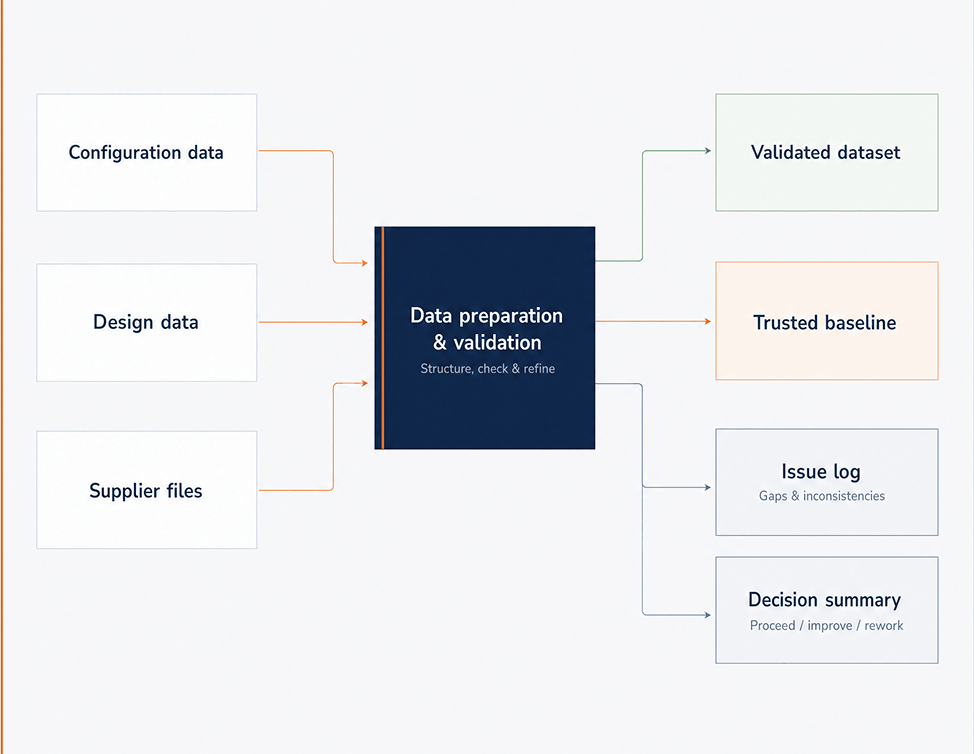
Validated dataset, issue log, and decision summary.
Clear decision
Proceed, improve, or rework based on evidence.
Start a Data Preparation & Validation assessment
Share a few details and a Prover expert will help define the right assessment scope.
Untrusted data creates risk across the signaling lifecycle
Configuration and design data often become a hidden source of project risk. Small inconsistencies can create large downstream consequences.
— Where it matters
Every downstream step depends on trustworthy data
Before you can build, prove, migrate, or evolve safely, you need to know whether the data foundation is reliable.
A focused assessment that turns uncertain data into decision-ready insight
Data Preparation & Validation evaluates and improves the quality, consistency, and usability of configuration or design data for a defined signaling scope.
Prover applies structured data intake, automated validation, and limited refinement to identify gaps, inconsistencies, rule violations, and improvement needs.
Built for teams that depend on trustworthy signaling data
Modern rail control systems depend on correct configuration and application data. But when data is created, exchanged, and corrected manually, quality issues often surface late – where they are harder and more expensive to fix.
Infrastructure Managers
Improve confidence in asset and project data
Create better confidence in data used for procurement, validation, digital twins, migration, upgrades, and long-term asset control.
Suppliers & Integrators
Reduce integration risk and rework
Clarify whether data is suitable for engineering, automation, simulation, or verification before it causes late-stage findings.
Consultants & Engineering Firms
Assess readiness and define a path forward
Use a structured way to identify gaps, support assurance planning, and define practical improvement paths for clients.
Clear findings, structured outputs, and a practical next step
The engagement combines a clear assessment flow with decision-ready deliverables. The goal is not to solve every data issue immediately — it is to create clarity, confidence, and a practical next step.
How Prover works
We move from scope definition to structured validation, issue analysis, and decision support in a controlled sequence.
What the customer receives
Concrete outputs that support decision-making and follow-on work.
— How it works
From trusted data to scalable signaling engineering
The assessment is designed to create a trusted baseline that can support the next engineering step in a practical lifecycle sequence.
Week 0
Onboarding and scope lock
Agree data scope, intended use, inputs, assumptions, and success criteria.
Week 1-2
Data intake and structuring
Collect, organize, and structure the data into a form suitable for validation.
Week 3-4
Validation and analysis
Run validation checks and identify gaps, inconsistencies, and rule violations.
Week 5
Improvement proposals
Prepare correction proposals, recommendations, and next-step options.
Week 6
Readout
Present results and recommend whether to proceed, improve, or rework.
Yes
The data is usable
The data can be structured and validated. Issues are limited or manageable.
Next step: proceed to downstream engineering, integration, simulation, verification, or expansion.
Conditional yes
The data has value but needs improvement
The data can support the intended purpose, but targeted improvements are needed.
Next step: perform focused correction, refinement, or extension.
No
The data foundation is not ready
The data is too incomplete, inconsistent, or immature for the intended use.
Next step: rework the data foundation before using it in critical downstream processes.
— What comes next
A practical assessment in approximately six weeks
The engagement is designed to create value quickly without requiring a large transformation project.
Step 1
Trusted data baseline
Validate and structure the data foundation so downstream engineering can begin with greater confidence.
Step 2
Digital twins & simulation
Use validated data to support digital models, simulation environments, and system understanding.
Step 3
Verification & acceptance
Strengthen formal verification, testing, and acceptance-readiness using trusted engineering inputs.
Step 4
Automation & migration
Support SDA workflows, migration programs, modernization initiatives, and lifecycle evolution.
Step 5
Lifecycle control
Reuse validated baselines across upgrades, recurring changes, maintenance, and future releases.
Data quality is not just a data problem. It is an engineering confidence problem.
Signaling systems verified
Markets worldwide
Before you automate, simulate, verify, migrate, or upgrade – make sure the data can be trusted.
Data Preparation & Validation gives you a focused, practical way to assess data quality, identify risk, and decide the right next step.
Share a few details and a Prover expert will help define the right assessment scope.
Focused scope
Start with one dataset, area, or boundary.
Decision-ready output
Know whether to proceed, improve, or rework.
Start a Data Preparation & Validation assessment
Share a few details and a Prover expert will help define the right assessment scope.


