
Generate stronger safety evidence for signaling sign-off
Safety sign-off in railway signaling depends on more than proving that a system works. It requires complete, traceable, reproducible, and assessor-ready evidence.
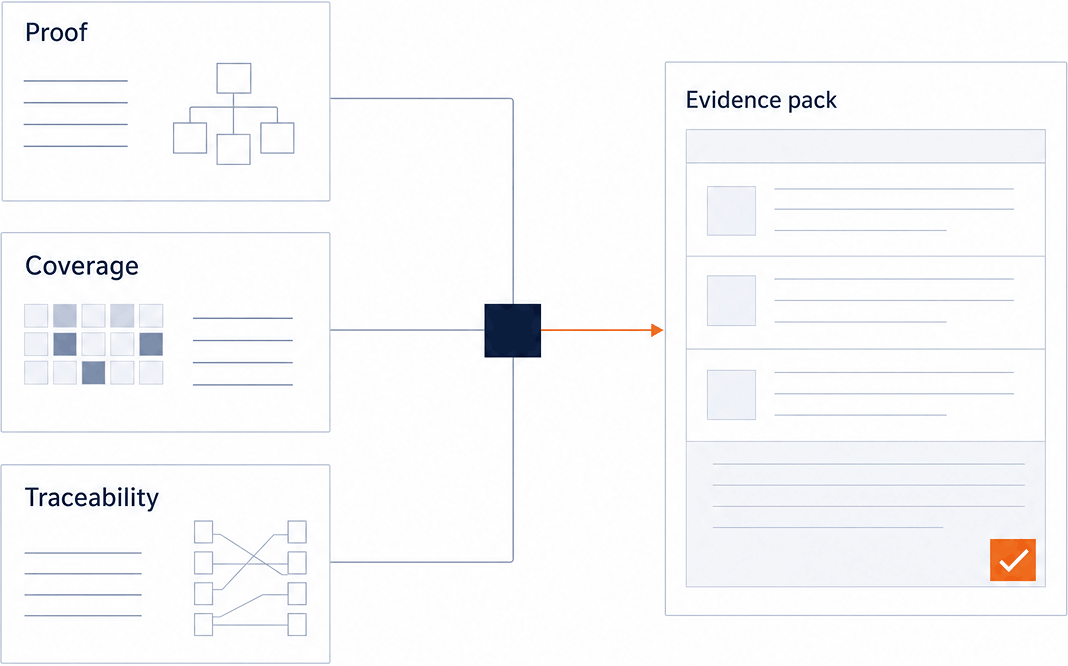
Prover helps railway teams turn verification results, proof artifacts, coverage reports, traceability, and structured documentation into stronger evidence packs for high-assurance signaling projects, including SIL4 environments where applicable.
Scattered evidence
Evidence is spread across tools, documents, reports, and teams.
Weak traceability
Requirements-to-verification traceability is incomplete or difficult to explain.
Manual coverage arguments
Coverage arguments are created manually and inconsistently.
Late assessor findings
Independent safety assessors may raise findings late in the project.
Rework and delays
Clarification loops and re-submissions delay sign-off readiness.
Late-stage evidence scramble
The proof that the system is safe and complete is not structured enough.
Safety evidence is not paperwork. It is the proof layer for SIL4 sign-off.
In high-assurance railway signaling, sign-off depends on demonstrating that the system meets its safety and functional requirements in a complete, traceable, and credible manner.
Level 0 — Create the truth
Trusted baseline
Define and structure requirements, assumptions, safety principles, data, and system logic.
Level 1 — Build and prove
Verification and evidence
Verify safety-critical behavior, generate proof results, create coverage outputs, and prepare sign-off evidence.
Level 2 — Evolve safely
Reusable assurance
Reuse and update evidence packs when systems are modified, upgraded, or migrated.
What you gain from Sign-off Verification
Create stronger evidence packs that support safety review, sign-off readiness, and lifecycle assurance.
Stronger safety evidence
Connect requirements, verification results, coverage, assumptions, and documentation.
Reduced sign-off risk
Reduce late assessor findings, missing traceability, and inconsistent documentation.
Better requirement coverage visibility
Show how requirements are covered by proof results and verification artifacts.
More reproducible results
Make proof runs, models, and verification outputs easier to reproduce and review.
Faster safety review preparation
Reduce manual effort for QA, assessor review, and certification support.
Better evidence reuse
Reuse structured proof and documentation assets across future releases and projects.
For teams responsible for acceptance, assurance, and safety sign-off
Infrastructure managers
Improve confidence in acceptance readiness, assessor review, operational handover, and lifecycle assurance by creating stronger traceability between requirements, verification activities, and safety evidence.
Suppliers & integrators
Reduce sign-off risk, improve evidence quality, and create more structured verification outputs before acceptance, customer review, and operational deployment.
V&V and safety teams
Strengthen traceability between requirements, proof results, coverage information, findings, and documentation to support assurance and sign-off activities.
Consultants & engineering firms
Assess evidence readiness, identify traceability gaps, and support customers in preparing stronger evidence packages for acceptance and safety review.
Start from the sign-off challenge you have today
Start from the data challenge you have today
Evidence pack generation
Turn existing verification outputs into a structured evidence pack.
SIL4 evidence readiness review
Assess whether current outputs are strong enough for high-assurance review.
Requirements-to-proof traceability
Improve traceability between requirements, proof results, coverage, and documentation.
Assessor and QA preparation
Prepare structured material for QA teams and independent safety assessors.
Reusable evidence workflow
Create repeatable workflows for future releases, variants, and projects.
Building confidence across acceptance and sign-off workflows
Interlocking systems
Connect requirements, verification results, coverage information, and safety evidence for routes, signals, points, and interlocking logic.
ERTMS / ETCS
Improve evidence readiness across complex programs involving standards, national rules, operational scenarios, configuration data, and verification activities.
CBTC
Create stronger evidence foundations for automation functions, degraded modes, interfaces, operational scenarios, and safety-critical behavior.
Digital twins
Transform simulation results, proof outputs, and model-based verification activities into structured evidence that supports acceptance and assurance.
Open signaling
Maintain traceability across modular architectures, reusable components, interfaces, and multi-supplier environments.
Migration & modernization
Demonstrate that safety-critical behavior has been preserved, improved, or intentionally changed through structured verification evidence.
Learn more about sign-off verification

Learn how to turn fragmented signaling requirements, specifications, and engineering knowledge into a structured, traceable, and trusted baseline. This webinar explores how Requirement Engineering and Specification Intelligence create a stronger foundation for digitalization, verification, automation, migration, and AI-assisted engineering.
Learn how open signaling helps infrastructure managers reduce lifecycle costs, avoid vendor lock-in, and gain greater control of their signaling systems. This webinar explores how open standards, COTS-based architectures, and a competitive supplier ecosystem enable more flexible and sustainable railway signaling.

How can rail projects move beyond manual data preparation? In this webinar, we show how Signaling Design Automation and formal verification enable a more controlled, efficient, and verifiable approach to generating and validating application data.
Built for high-assurance railway signaling evidence
Prover combines railway signaling expertise, formal methods, digital twins, verification workflows, and safety evidence generation.
By connecting requirements, proof results, simulation outputs, coverage information, findings, and traceability, Prover helps create evidence that is easier to review, reproduce, explain, and trust.


