
From system intent to verified behavior
From system intent to verified behavior
The Prover Engineering Methodology helps railway teams create trusted foundations, prove system behavior, and maintain confidence through lifecycle change.
A specification-driven, model-based, and formally verified approach to safer engineering.
Methodology workflow
Why Prover works this way
Safety-critical engineering is becoming more complex. Systems are more software-driven, data and configuration play a larger role, and requirements are often spread across documents, tools, suppliers, and experts.
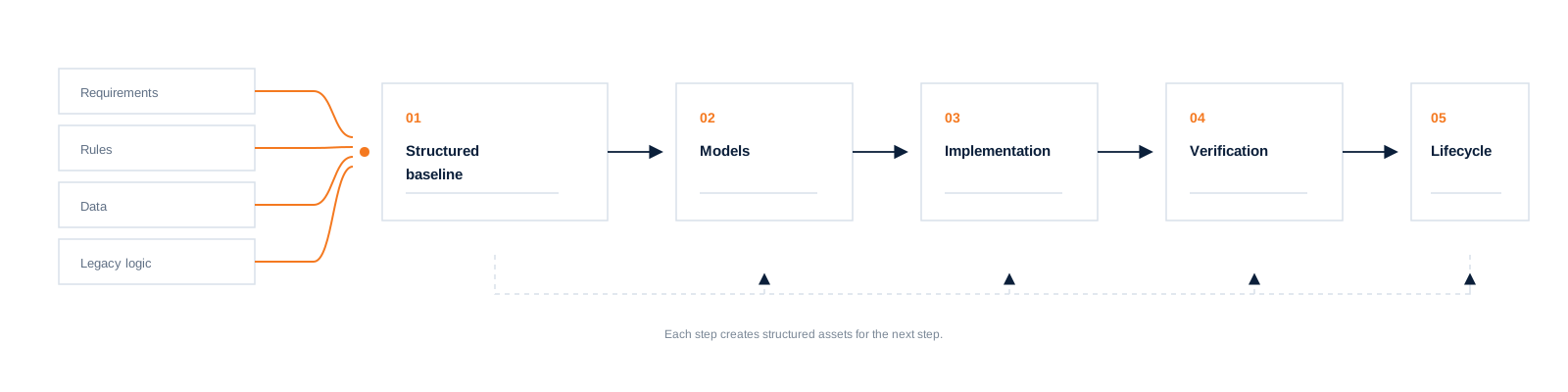
A structured way to move from intent to proof
The Prover Engineering Methodology is built around five connected engineering steps. Each step produces assets that strengthen the next step, so engineering work becomes more repeatable and less dependent on late interpretation.
The methodology does not replace the safety lifecycle or the V-model. It reinforces them by making intent more precise, behavior executable, implementation controllable, verification more rigorous, and evidence easier to reuse through change.
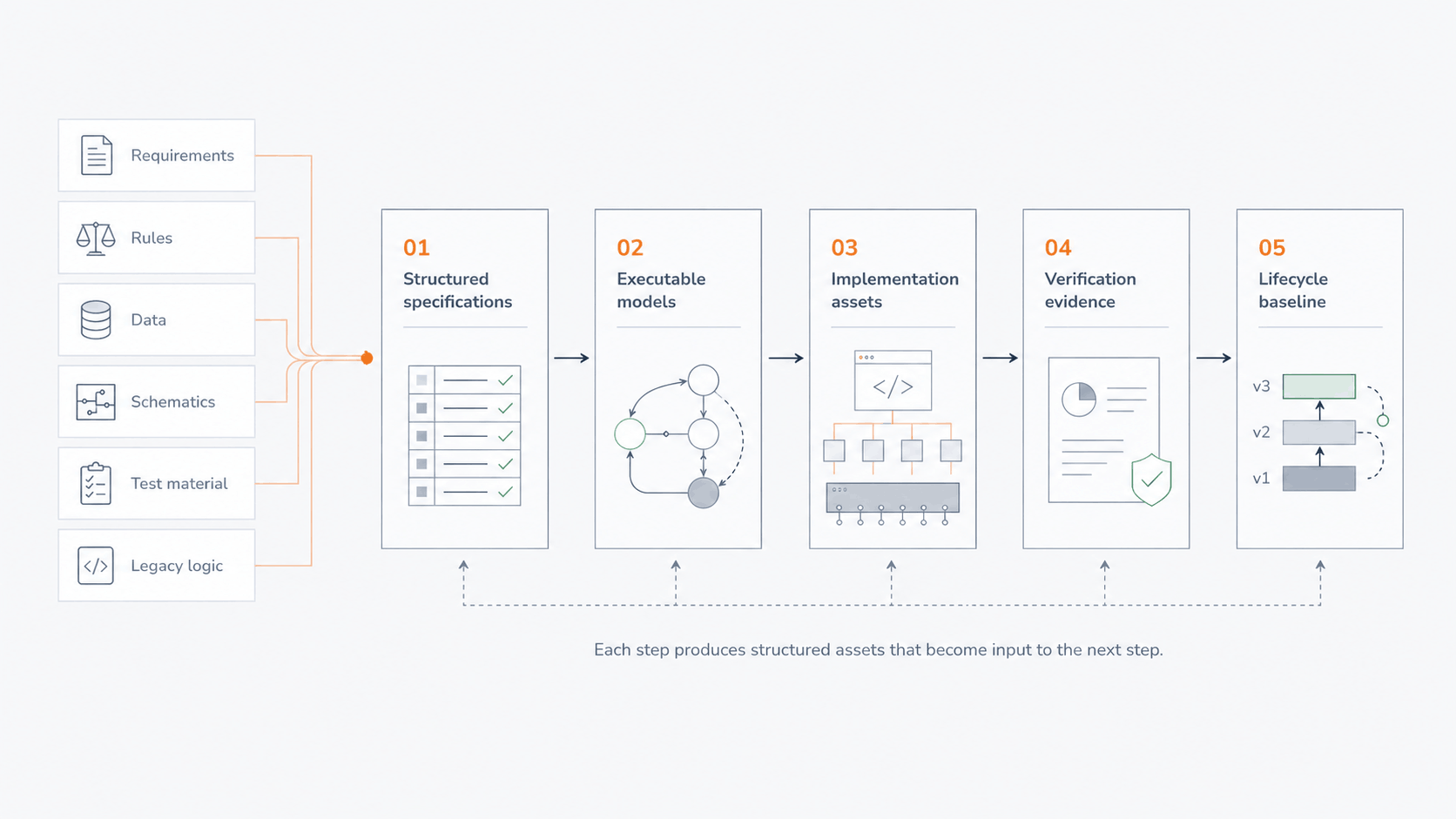
Engineering assets, not just documents
Each methodology step produces structured assets that become inputs to the next step – reducing interpretation, rework, and late-stage risk.
Three levels of lifecycle maturity
The methodology is organized into three levels that describe where a project or program is in its engineering maturity – and what kind of value it is ready to create.
Create the truth
Build a trusted and structured baseline that engineering, automation, verification, and lifecycle management can rely on.
- Structured requirements and specifications
- Validated configuration and design data
- Traceable engineering knowledge
- Formalized rules and principles
- Baseline for downstream engineering
Build and prove
Move from document-centric and test-heavy workflows to model-based and evidence-driven engineering.
- Executable models and digital twins
- Simulation of scenarios and edge cases
- Automated design or configuration workflows
- Formal verification of critical properties
- Traceable proof and acceptance evidence
How the methodology
becomes practical
Each use case is an application of the same methodology logic: create a reliable baseline, prove the behavior, or maintain confidence through change.
Level 0 — Foundational Baseline
LEVEL 1 — System Realization
LEVEL 2 — Lifecycle Evolution
AI can accelerate engineering. The methodology defines the control layer.
AI can support extraction, structuring, generation, analysis, documentation, and reuse of engineering knowledge. In safety-critical systems, those outputs still need boundaries, traceability, validation, and proof.
Prover’s methodology helps ensure that accelerated engineering remains controlled, explainable, and verifiable.

Different roles, one connected method
The methodology gives each role a clearer way to connect its work to verified behavior and reusable evidence.
Infrastructure Managers
Control the lifecycle
Stronger control over requirements, data, suppliers, system logic, modernization, and lifecycle change.
Suppliers & integrators
Reduce delivery risk
More repeatable engineering, earlier verification, better evidence quality, and fewer costly late-stage findings.
V&V and safety teams
Strengthen assurance
Clearer traceability between requirements, verification results, coverage, and assessor-ready evidence.
Consultants & partners
Scale expertise
A repeatable framework for specification, procurement, assurance, modernization, and delivery support.
Start with one bounded engineering problem
The methodology does not require a full lifecycle transformation from day one. It can be applied to a focused problem – unclear requirements, poor data, acceptance risk, evidence pressure, automation potential, or migration uncertainty – while still creating reusable value for the next step.
Starter
Specification Intelligence Starter
Build a stronger understanding of existing railway systems and requirements before change, tendering, or modernization.
Read more
Sprint
Acceptance Proof Sprint
Reduce risk before FAT, SAT, and site windows with earlier verification and traceable proof of key railway principles.
Read more
Apply the methodology in practice
Prover’s methodology can be explored through railway use cases, focused engagements, or a deeper discussion of how requirements, models, verification, evidence, and change connect in your engineering lifecycle.
Create the truth. Build and prove. Evolve safely.


