
Prove critical signaling principles before costly test windows begin
Railway signaling projects depend on proving that safety principles, requirements, and system behavior hold before costly acceptance and site activities begin.
This sprint helps railway teams use simulation and formal verification to check a bounded set of principles before defects become expensive to diagnose, correct, and retest.
4–6 week sprint
Create proof-based insight before FAT, SAT, or site testing.
Bounded proof scope
Select principles, requirements, release scope, or system behavior.
Coverage clarity
See what has been proven, simulated, and left outside scope.
Release decision basis
Know whether to proceed, correct, or expand the proof scope.
Start an Acceptance Proof Sprint
Share a few details and a Prover expert will help define the right proof scope before acceptance risk becomes costly.
Late proof creates rework when test windows are already constrained
By the time a system reaches FAT, SAT, or site testing, requirements have been interpreted, designs implemented, interfaces integrated, and delivery schedules put under pressure.
— Where it matters
Test readiness depends on proving the right behavior early
Before you enter expensive lab, customer, or site windows, you need stronger proof that critical behavior is correct.
A proof sprint for the principles that must not fail late
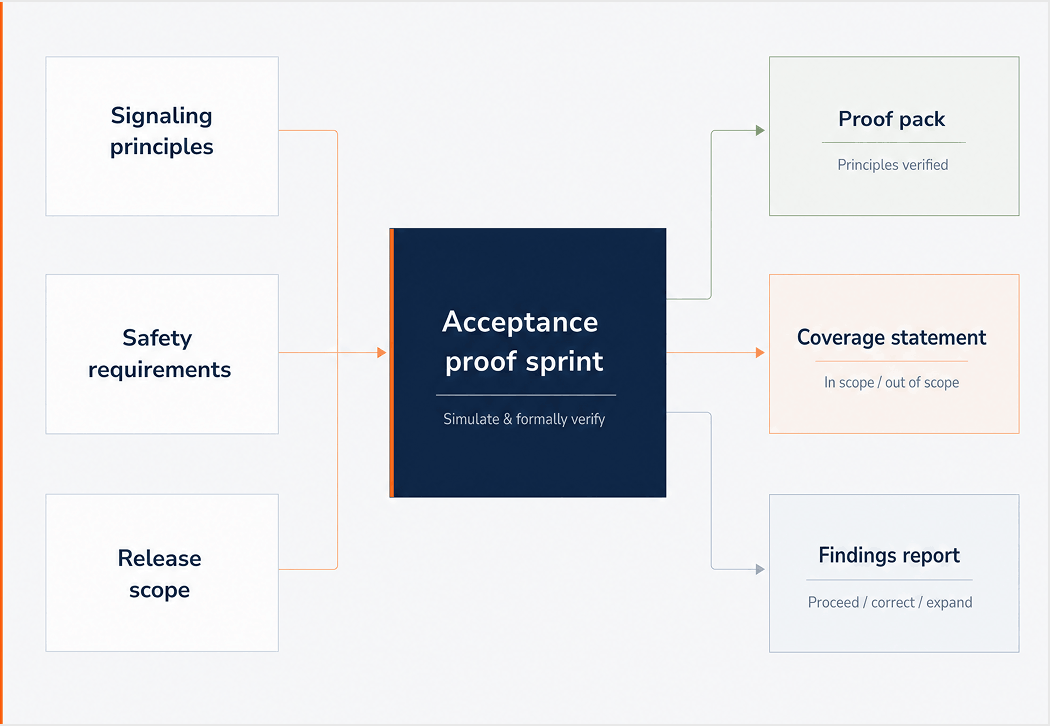
Acceptance Proof Sprint uses simulation and formal verification to prove a bounded set of signaling principles, safety requirements, or release-critical properties.
Prover helps define the proof scope, set up relevant models or digital representations, translate selected principles into verifiable properties, run simulation scenarios and formal proofs, and produce a traceable proof pack.
For teams that need stronger confidence before test pressure peaks
For infrastructure managers, suppliers, integrators, consultants, and V&V teams that need stronger confidence before supplier delivery, FAT, SAT, site testing, QA review, or release approval.
Infrastructure Managers
Improve confidence before delivery decisions
Reduce the risk of late findings, unclear coverage, and project delays while creating a clearer basis for supplier, assessor, and stakeholder dialogue.
Suppliers & Integrators
Reduce delivery risk before formal test gates
Identify defects earlier, demonstrate stronger coverage, reduce retesting effort, and show that key safety principles have been systematically checked.
Consultants & Engineering Firms
Support test readiness and independent review
Help clients understand whether selected principles, requirements, or system behaviors are ready for the next project gate or need further work.
A proof package built around principles, coverage, and findings
The sprint combines proof scope definition, property formalization, simulation, formal verification, findings analysis, and decision support. The goal is not to replace all testing – it is to prove selected critical behavior before late-stage pressure escalates.
How Prover turns selected principles into proof-based insight
We move from acceptance context and principle selection to verifiable properties, simulation scenarios, formal proof, and a traceable proof pack.
What the customer receives
Concrete outputs that support test readiness, decision-making, and follow-on work.
— How it works
A practical proof sprint before late findings become expensive
The engagement is designed to create proof-based clarity before FAT, SAT, site testing, or release approval becomes the constraint.
Week 0
Onboarding and scope lock
Agree the selected scope, acceptance context, input material, principles, assumptions, and success criteria.
Week 1
Principle selection and model setup
Define the proof target, select relevant principles or requirements, and prepare the model or digital representation.
Week 2-3
Property formalization
Translate selected principles into verifiable properties and prepare relevant simulation scenarios.
Week 3-4
Formal verification and analysis
Run formal proofs, analyze results, identify counterexamples or violations, and document findings.
Week 5
Findings review and optional rerun
Clarify findings, confirm fixes, or rerun selected checks where feasible within the sprint.
Week 6
Readout and decision support
Present the proof pack and recommend whether to proceed, correct, or expand the proof scope.
Yes
The selected scope is ready for the next gate
The selected principles have been proven or validated within the agreed scope. Findings are limited or manageable.
Next step: proceed toward FAT, SAT, site testing, review, or broader verification.
Conditional yes
Confidence is improved, but issues need correction
The sprint shows clear value, but selected findings must be resolved before the next project gate.
Next step: correct issues, rerun selected proofs, and update the Acceptance Proof Pack.
No
Proof confidence remains too low
The selected scope contains significant unresolved issues, unclear requirements, insufficient model maturity, or gaps that prevent meaningful confidence.
Next step: improve requirements, data, model quality, or implementation before moving further into costly test activities.
— What comes next
From one proof sprint to repeatable release confidence
Step 1
Proof scope expansion
Extend the selected principles, requirements, or system behaviors into a broader verification scope.
Step 2
Sign-off evidence
Turn proof results into structured evidence for safety case, assessor review, and sign-off.
Step 3
Recurring release gates
Use the same proof approach to assess future releases, deltas, and configuration changes.
Step 4
Digital twin reuse
Build or improve digital representations of system behavior for simulation, validation, and change control.
Step 5
Data and automation readiness
Strengthen the data and model foundations used for proof, testing, SDA, and future releases.
Step 6
Lifecycle confidence
Reuse proof packs and regression verification to maintain confidence through upgrades, modifications, and maintenance.
Confidence before testing is an engineering proof problem.
Prover works at the intersection of signaling knowledge, formal methods, digital twins, simulation, verification, and lifecycle assurance.
That means readiness is treated as a proof-based engineering workflow that connects requirements, models, principles, simulation, verification, findings, and evidence.
Signaling systems verified
Markets worldwide
Before FAT, SAT, or site testing begins, prove the principles that matter most.
Acceptance Proof Sprint gives you a focused, practical way to prove selected behavior, identify late-stage risk, and decide the right next step.
Share a few details and a Prover expert will help define the right proof sprint scope.
Focused scope
Start with one system, release, area, or principles cluster.
Proof-ready output
Know whether to proceed, correct, or expand the proof scope.
Request sprint scoping
Tell us what proof scope, principle, or late-stage risk you want to assess.


