
Understand legacy behavior before you rebuild it on a new platform
Railway signaling modernization projects often involve migrating from legacy systems to new platforms, digital architectures, or more open signaling environments.
This sprint helps railway teams reveal the behavior, dependencies, and safety-critical assumptions that must be preserved, challenged, or verified before modernization moves forward.
4–6 week sprint
A controlled starting point before modernization accelerates.
Behavior preservation
Clarify what the future system must keep, change, or replace.
Equivalence exposure
Surface where old and new behavior may no longer match.
Modernization gate
Decide whether the scope is ready for the next migration step.
Start a migration readiness sprint
Share a few details and a Prover expert will help define the right migration assessment scope.
Legacy systems carry behavior that documents rarely explain completely
Legacy systems often contain decades of operational knowledge, undocumented assumptions, local adaptations, and engineering decisions that are difficult to reconstruct.
— Where it matters
Modernization starts by separating what must be preserved from what can change
Before a legacy system is replaced, reimplemented, or integrated with a new architecture, teams need a clear view of which behaviors are safety-critical, which assumptions are historical, and which differences must be proven acceptable.
A controlled starting point for high-risk signaling modernization
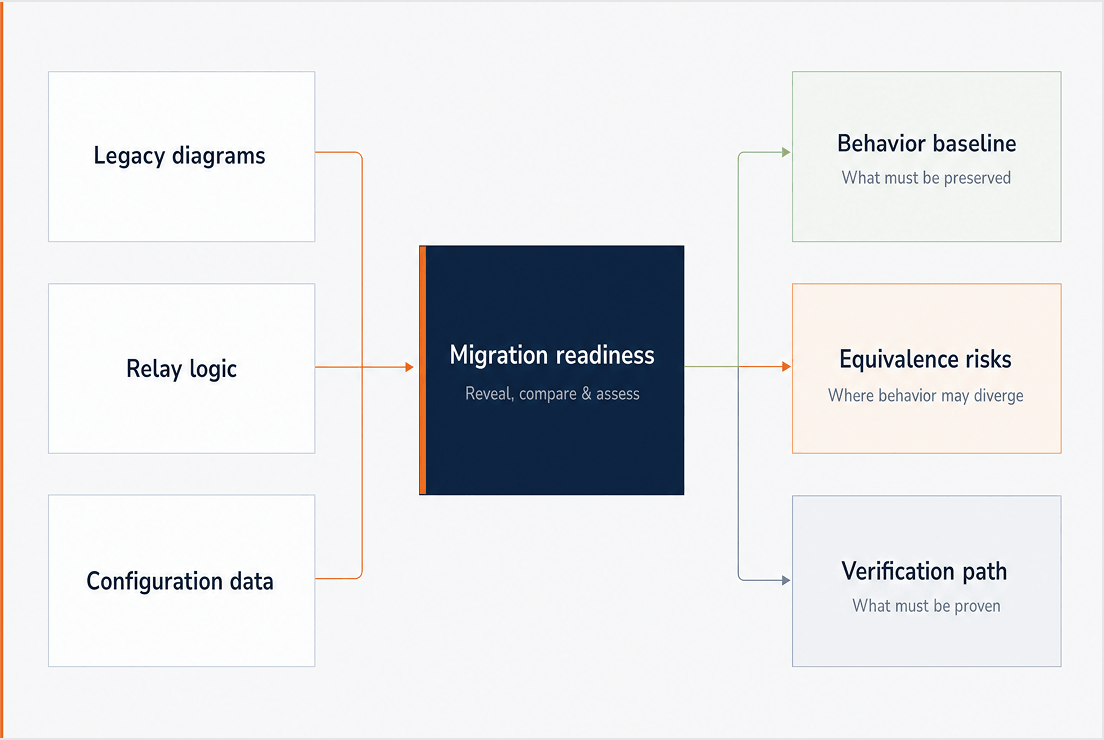
Migration Readiness & Equivalence Risk Sprint investigates a bounded legacy signaling scope and identifies what the new platform must preserve, where behavior may diverge, and what evidence will be needed to justify the transition.
Prover helps collect and review available legacy material, extract relevant behavior, identify safety-critical principles, create an initial behavioral baseline, and assess where equivalence risk may appear when moving to a new platform or architecture.
For teams accountable for continuity, safety, and control during modernization
For infrastructure managers, suppliers, integrators, consultants, and engineering partners that need to modernize aging signaling assets without losing control of operational behavior, safety principles, or future architecture choices.
Infrastructure Managers
Gain control before modernization decisions
Reduce uncertainty around legacy behavior, supplier transition, open signaling migration, long-term asset strategy, and acceptance risk.
Suppliers & Integrators
Clarify legacy behavior before implementation
Support equivalence proof, reduce rework, plan staged rollout, and avoid late discovery of hidden dependencies.
Consultants & Engineering Firms
Create an evidence-based migration path
Support migration planning, legacy analysis, risk assessment, and modernization strategy with a structured method.
A migration readiness package built around behavior, gaps, and proof needs
The sprint combines legacy material review, behavior extraction, equivalence risk analysis, and a recommended verification path. The goal is not to perform the full migration — it is to reveal what must be preserved, clarified, or proven before the migration program commits to a direction.
How Prover turns legacy artifacts into a modernization basis
We move from legacy artifacts and engineering knowledge to a clearer picture of required behavior, critical unknowns, and the proof path needed for migration.
What the customer receives
Concrete outputs that support migration planning, decision-making, and follow-on work.
— How it works
A controlled sprint before platform transition begins
The engagement is designed to create clarity before migration decisions turn into implementation commitments, supplier dependencies, or acceptance risk.
Week 0
Onboarding and scope lock
Agree legacy scope, migration context, available material, assumptions, stakeholders, and success criteria.
Week 1
Legacy material intake
Collect, review, and classify available documentation, data, diagrams, requirements, or system descriptions.
Week 2-3
Behavior extraction
Extract system behavior, structure assumptions, identify safety-critical logic, and create an initial baseline where feasible.
Week 4
Equivalence risk analysis
Assess gaps, unclear behavior, data issues, interface assumptions, and potential differences between old and target behavior.
Week 5
Verification path
Define what should be simulated, proven, validated, or documented in the next phase.
Week 6
Readout
Present findings and recommend whether to proceed, prepare, or perform deeper analysis.
Yes
The selected scope is migration-ready
The legacy behavior can be structured and understood. Key risks are limited or manageable.
Next step: proceed to migration planning, digital twin development, data validation, equivalence proof, or implementation preparation.
Conditional yes
Migration is possible, but preparation is needed
Selected gaps, unclear behavior, or data issues must be resolved first.
Next step: perform focused legacy clarification, data preparation, formalization, modeling, or proof planning.
No
Migration risk is too high for this scope
The selected legacy scope is poorly documented, inconsistent, unclear, or immature.
Next step: deepen legacy analysis, reconstruct system behavior, or rework the knowledge foundation before migration continues.
— What comes next
From hidden legacy behavior to a governed migration path
Step 1
Behavior reconstruction
Make legacy assumptions, principles, dependencies, and operating behavior explicit enough to discuss and review.
Step 2
Migration data readiness
Validate the configuration and design data needed to compare, simulate, or reimplement the legacy scope.
Step 3
Digital behavior model
Create or improve a digital representation of current behavior and the intended target behavior.
Step 4
Equivalence proof path
Define the properties, scenarios, and principles that must be proven before acceptance or staged rollout.
Step 5
Assurance and handover
Prepare evidence, documentation, and review material that support safety case, supplier transition, and sign-off.
Step 6
Long-term control
Reuse the migration baseline for future changes, upgrades, regression checks, and lifecycle governance.
Modernization succeeds when behavior transfer is engineered, not assumed.
Prover works at the intersection of signaling knowledge, formal methods, digital twins, verification, automation, and lifecycle assurance.
That means migration is treated as an engineering evidence problem: existing behavior must be understood, the target behavior must be explicit, and every intended change or preserved function must be justified.
Signaling systems verified
Markets worldwide
Before legacy signaling is replaced, make the behavior visible.
Migration Readiness & Equivalence Risk Sprint gives you a focused way to reveal hidden behavior, expose equivalence risk, and decide whether the scope is ready for the next modernization step.
Share a few details and a Prover expert will help define the right migration sprint scope.
Focused scope
Start with one system, subsystem, area, or migration boundary.
Decision-ready output
Know whether to proceed, prepare, or analyze deeper.
Request sprint scoping
Tell us what legacy migration challenge you want to assess.


