
Hazard-based formal verification that challenges safety mitigations before deployment
Prover Diagnostic is a packaged, hazard-based formal verification solution that helps identify and eliminate potential safety risks early – before they become costly or difficult to change.
Instead of only verifying that requirements are implemented as written, Prover Diagnostic asks a tougher question: Are your mitigations actually sufficient to prevent hazardous states?
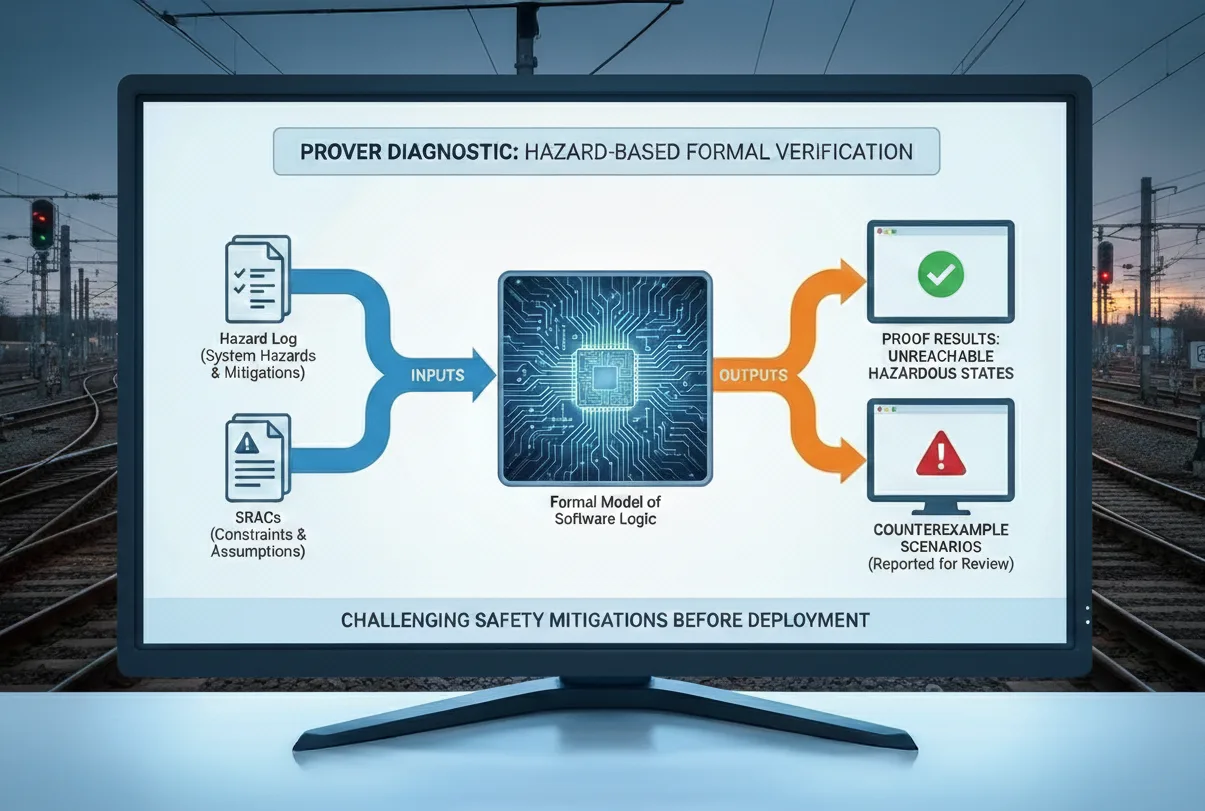
At a glance: Inputs and outputs
Request a proposal (customer-specific scope and pricing)
I’m interested in Prover Diagnostic
Start strengthening your safety assurance; fill out the form to learn more.








What makes Prover Diagnostic different?
Formal verification is often requirements-driven, tracing properties back to safety requirements. This approach supports testing (TST) and verification (VER) teams through exhaustive exploration using the Prover PSL proof engine, aligned with CENELEC norms.
Prover Diagnostic takes a different angle: it supports the Safety Assurance team by deriving safety properties directly from system hazards and the Hazard Log, introducing automation into a part of safety assessment that has traditionally been manual.
This provides an independent and complementary way to challenge mitigations, strengthening functional safety analyses with objective, model-based evidence.
How Prover Diagnostic works

1) Identify safety properties from hazards
Safety properties are modeled from system hazards, such as:
- collision scenarios
- derailment scenarios
This ensures direct traceability between identified hazards and the formal properties used to challenge the design.

2) Define an environment model and constraints (SRACs)
An environment model captures safety-related constraints of:
- wayside components (e.g., switch machines)
- interfacing subsystems
- operational procedures
For example, the environment model can ensure that a switch cannot change position unless it has been commanded or manually operated.

3) Analyze the software logic using formal proof
These elements are used to analyze a formal model of the logic (automatically generated or imported from an existing design).
The analysis exhaustively explores the modeled behaviors under defined assumptions and constraints. Hazardous states are either proven unreachable within the model or reported with a scenario that supports review and targeted improvement.
Why choose Prover Diagnostic?
Book a meeting
Get a customer-specific proposal for Prover Diagnostic
Share a few details about your project and we will get back to discuss scope, inputs, and expected deliverables.
Typical inputs include:
- Hazard Log
- SRACs/operational constraints
- A model of the software logic
I’m interested in a Prover Diagnostic. Contact me!


