
Turn fragmented signaling specifications into trusted engineering foundations
Railway signaling projects depend on requirements, rules, drawings, logic, and engineering knowledge that are clear, traceable, and verifiable.
Specification Intelligence Starter helps you extract, structure, validate, and clarify existing signaling specifications and engineering knowledge before they are used for automation, verification, migration, procurement, or lifecycle change.
4–6 week engagement
Assess specification quality without starting a full transformation project.
Defined scope
Focus on one subsystem, document set, engineering boundary, or requirement area.
Structured outputs
Create traceable engineering structures from fragmented material.
Decision-ready insight
Understand what can be trusted and what must be improved.
Start a specification assessment
Tell us what specification scope, subsystem, or engineering material you want to assess.
Fragmented specifications create risk before engineering even starts
When specifications are difficult to understand, connect, or verify, every downstream engineering activity becomes harder to control.
— Where it matters
Specifications shape every downstream engineering and assurance activity
Before you can automate, verify, migrate, or evolve safely, you need to understand what the system is supposed to do – and whether that understanding can be trusted.
Transform scattered engineering material into structured engineering insight
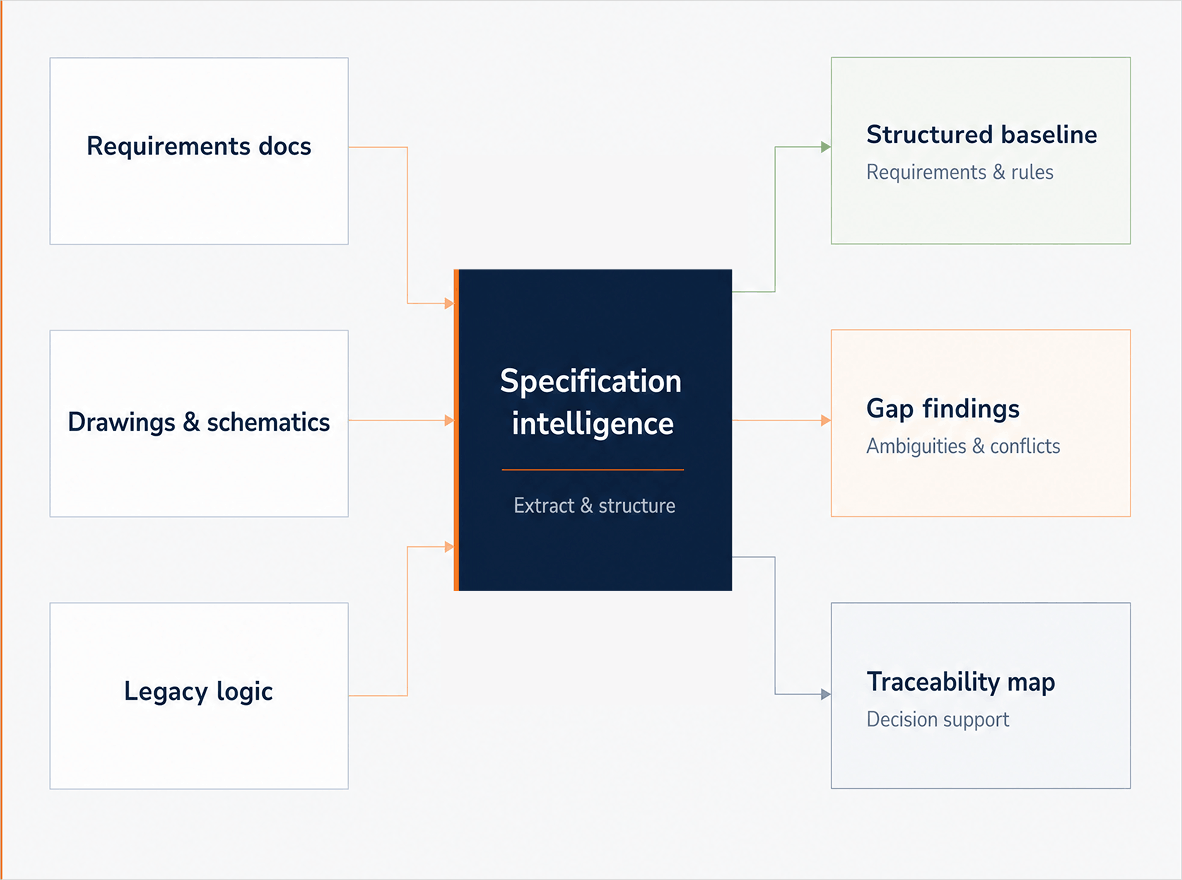
Specification Intelligence Starter extracts, structures, validates, and clarifies existing specifications and engineering artifacts for a bounded signaling scope.
Prover helps collect, review, extract, and structure relevant information from requirements documents, drawings, schematics, relay logic, control tables, operational descriptions, code, test material, and supplier documentation.
Built for teams that depend on trustworthy signaling data
Infrastructure Managers
Create stronger control over signaling knowledge
Reduce ambiguity before tenders, modernization programs, upgrades, migration projects, or digital twin initiatives.
Suppliers & Integrators
Clarify what the system must do before delivery risk increases
Create stronger inputs for design, configuration, implementation, testing, and verification workflows.
Consultants & Engineering Firms
Assess specification quality in a structured way
Support requirement improvement, procurement support, assurance planning, and migration preparation.
A guided assessment package with concrete outputs
How Prover structures and validates specification foundations
The engagement combines source intake, information extraction, structuring, formalization, consistency analysis, and decision support.
What the customer receives
— How it works
A practical assessment before specification problems become engineering problems
Week 0
Onboarding and scope lock
Define the selected scope, intended use, assumptions, and success criteria.
Week 1-2
Source intake
Collect, classify, and structure the relevant engineering material.
Week 1-2
Extraction and analysis
Extract requirements, rules, assumptions, and dependencies while performing consistency analysis.
Week 5
Improvement recommendations
Prepare findings, improvement proposals, and baseline strengthening options.
Week 6
Readout and decision support
Explain what can be trusted, what must improve, and what should happen next.
Yes
The specification foundation is usable
The material can be structured and used as a baseline. Issues are limited or manageable.
Next step: proceed to modeling, data validation, SDA, simulation, verification, tendering, or migration planning.
Conditional yes
The specification has value but needs improvement
Targeted clarification, structuring, or formalization is needed before downstream use.
Next step: perform focused requirement improvement, model preparation, or specification refinement.
No
The specification foundation is not ready
The material is too incomplete, inconsistent, ambiguous, or undocumented for the intended use.
Next step: rework the specification foundation before using it in critical downstream processes.
— What comes next
From trusted specifications to trusted engineering
Step 1
Data Preparation & Validation
Connect structured requirements and system knowledge to validated data inputs.
Step 2
Signaling Design Automation
Use structured specifications for more automated design and configuration workflows.
Step 3
Digital twins
Create executable models that make behavior visible and testable earlier.
Step 4
Verification and acceptance
Use structured requirements for simulation, proof, traceability, and acceptance readiness.
Step 5
Lifecycle change management
Reuse the baseline for updates, impact analysis, migration, and re-verification.
Specification quality is not just a documentation problem. It is an engineering confidence problem.
Signaling systems verified
Markets worldwide
Before you automate, verify, migrate, or upgrade, make sure the specification foundation can be trusted.
Specification Intelligence Starter gives you a focused, practical way to assess existing specifications, extract system knowledge, identify risk, and decide the right next step.
Structured specification baseline
Create clearer engineering inputs for downstream work.
Decision-ready insight
Understand whether the specification can support automation, verification, or migration.
Request assessment scoping
Tell us what subsystem, specification scope, or engineering challenge you want to assess.


