Reduce signaling acceptance risk
before FAT, SAT, and site testing
Reduce signaling acceptance risk
before FAT, SAT, and site testing
Acceptance testing in railway signaling is often constrained by limited FAT, SAT, lab, and site-testing windows. When issues are discovered late, rework becomes expensive, schedules are compressed, and confidence in coverage can be difficult to explain.
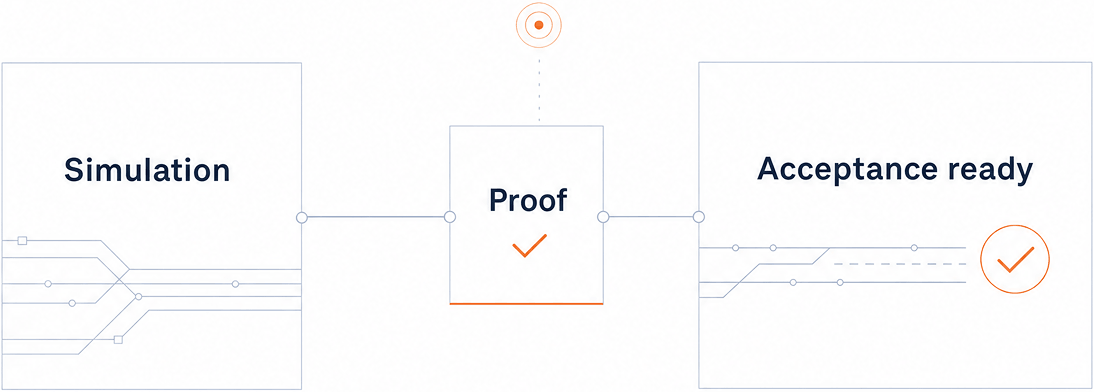
Prover helps railway teams test and prove key signaling principles earlier using digital twins, simulation, and formal verification.
Prove signaling principles before acceptance windows begin
Late defect discovery
Defects are discovered when correction costs are high.
Overloaded FAT & SAT
Acceptance windows become compressed and overloaded.
Weak coverage visibility
Test coverage is difficult to explain or justify.
Untested corner cases
Rare scenarios and edge cases may remain untested.
Repeated rework cycles
Late findings create delays and repeated testing.
Acceptance bottlenecks
Acceptance becomes a high-risk decision point instead of a controlled workflow.
Acceptance readiness depends on proving the right behavior early
Modern railway signaling systems are too complex to rely only on late-stage testing. Digital Principles Testing shifts confidence earlier through digital twins, simulation, and formal verification.
Level 0 — Create the truth
Trusted engineering inputs
Structure requirements, principles, data, and signaling logic so they can be tested and verified.
Level 1 — Build and prove
Digital principles testing
Use digital twins, simulation, formal verification, proof results, and findings to reduce acceptance risk.
Level 2 — Evolve safely
Reusable proof workflows
Reuse proof assets, regression checks, and verified principles across future releases and changes.
What you gain from Digital Principles Testing
Reduce acceptance risk and strengthen confidence before FAT, SAT, lab, and site-testing windows begin.
Earlier defect discovery
Find principle violations and unexpected behavior before expensive acceptance stages.
Stronger coverage confidence
Improve confidence beyond manually selected test cases.
Reduced acceptance risk
Understand what has been proven and what risks remain before acceptance.
Fewer late surprises
Reduce the likelihood that issues appear during expensive testing windows.
Faster remediation loops
Use findings logs and reruns to accelerate correction and closure.
Foundation for sign-off evidence
Create proof outputs that support later UC4 Sign-off Verification workflows.
For teams responsible for acceptance readiness and verification confidence
Infrastructure managers
Reduce acceptance risk before FAT, SAT, lab, or site-testing windows by gaining earlier visibility into whether key signaling principles and requirements hold.
Suppliers & integrators
Find principle violations and unexpected behavior earlier, reduce rework before customer acceptance, and create traceable proof outputs that support delivery confidence.
Consultants & engineering firms
Support independent verification, acceptance readiness reviews, and structured evidence preparation for customers, suppliers, and project stakeholders.
Start from the acceptance challenge you have today
Start from the data challenge you have today
Prove selected safety principles
Use formal verification and simulation to prove critical signaling principles.
Prepare for FAT and SAT
Reduce late failure risk before expensive acceptance windows begin.
Verify requirements coverage
Connect requirements, proof results, and coverage statements.
Independent verification
Independently analyze supplier-delivered logic, data, or configuration.
Regression proof for changes
Reuse principle checks across releases, upgrades, and modifications.
Applicable across signaling acceptance and verification workflows
Interlocking systems
Prove selected signaling principles, route logic, safety properties, and operational behavior before acceptance pressure escalates.
Metro and CBTC environments
Support earlier verification of selected behaviors, interfaces, degraded modes, and edge cases in complex, high-capacity signaling environments.
ERTMS and ETCS programs
Use simulation and formal verification where the scope is clearly defined and acceptance confidence depends on traceable proof of requirements or principles.
FAT, SAT, lab, and site-testing preparation
Reduce late surprises by proving critical behavior before expensive and limited FAT, SAT, lab, or site-testing windows begin.
Independent verification of supplier outputs
Analyze delivered logic, configuration, or implementation behavior against selected principles and requirements to strengthen confidence before acceptance decisions.
Release and regression verification
Reuse proof assets and simulation scenarios across updates, releases, and changes to confirm that previously verified principles still hold.
Learn more about formal verification

Learn how to turn fragmented signaling requirements, specifications, and engineering knowledge into a structured, traceable, and trusted baseline. This webinar explores how Requirement Engineering and Specification Intelligence create a stronger foundation for digitalization, verification, automation, migration, and AI-assisted engineering.

Learn how open signaling helps infrastructure managers reduce lifecycle costs, avoid vendor lock-in, and gain greater control of their signaling systems. This webinar explores how open standards, COTS-based architectures, and a competitive supplier ecosystem enable more flexible and sustainable railway signaling.

How can rail projects move beyond manual data preparation? In this webinar, we show how Signaling Design Automation and formal verification enable a more controlled, efficient, and verifiable approach to generating and validating application data.